Best Online Quran Classes with Tajweed For kids & Adults
Perfect your Quranic recitation with 1-on-1 personalized Tajweed classes for kids and adults—all from the comfort of home
Master Quran Reading Online with Tajweed
Many students feel anxious when they open the Quran for recitation, worried about pronouncing words incorrectly or dishonoring the sacred text through mistakes. That fear of mispronunciation keeps countless hearts from experiencing the profound beauty of proper recitation. Learning to read the Quran with Tajweed transforms this anxiety into confidence, turning each verse into a melodious prayer that honors both the word and the Speaker.
Reciting the Quran with proper Tajweed is deeply important for every Muslim, whether male or female. A single mispronounced letter can change the meaning of a verse, which is why learning correct pronunciation matters so much. This course offers a structured path for anyone seeking to recite beautifully and correctly—whether picking up the Quran for the first time or refining skills learned years ago.
Our expert Quran instructors guide students in mastering proper pronunciation, articulation points, and the unique characteristics of each Arabic letter. These comprehensive online Tajweed classes help learners recite with confidence and accuracy, deepening their spiritual connection with Allah through His sacred words.
What is Tajweed? (The Simple Explanation)
Tajweed literally means “to make better” or “to beautify.” When applied to Quran recitation, it refers to the art of pronouncing each letter from its correct point of origin with its proper characteristics. Think of it as giving every Arabic letter its full rights and dignity.
The word “Makhraj” describes the articulation point—essentially the “home” where each sound lives in the mouth or throat. Just as every person has a home address, every Arabic letter has a specific place from which it should emerge. When someone pronounces the letter ح (Ha), it comes from the middle of the throat, while ب (Ba) comes from the lips.
“Sifaat” refers to the characteristics or “personality” of each sound. Some letters are strong and forceful, others are soft and gentle. Some require a full breath, while others are crisp and brief. Understanding these characteristics helps students give each letter its unique identity, preventing confusion between similar sounds.
Learning Tajweed isn’t about making recitation complicated. It’s about honoring the Quran by reciting it as it was revealed, preserving the meaning that could change with a single mispronounced letter.
Course Objectives
This comprehensive program aims to help students achieve several key goals:
- Learn to pronounce Arabic letters correctly so every sound comes out clear and natural
- Understand how small changes in pronunciation can change meanings in the Quran
- Recite with a smooth, beautiful rhythm that feels peaceful and flows effortlessly
- Feel confident reading the Quran during prayers and in personal worship time
Each objective builds upon the previous one, creating a learning journey that feels natural rather than overwhelming.
Prerequisites
Students don’t need extensive knowledge to begin this course, but a few basic elements help ensure success:
- Ability to recognize Arabic letters (even if pronunciation isn’t perfect yet)
- A sincere heart and genuine intention to learn
- A stable internet connection for consistent online classes
For those who aren’t yet comfortable with Arabic letter recognition, Our Noorani Qaida course provides an excellent foundation. That program specifically teaches letter recognition and basic reading skills, preparing students perfectly for Tajweed instruction.
Who is this course for?
Kids and Beginners
Young learners and those just starting their Quran journey will find this course perfect for building strong foundations. Children’s minds naturally absorb new sounds and pronunciation patterns, making early Tajweed training incredibly effective. They develop the right habits from the start, learning to pronounce each letter correctly before any mistakes become ingrained.
The course uses simple, age-appropriate teaching methods that keep children engaged and excited about learning. Parents often notice their kids reciting verses around the house, proudly practicing what they’ve learned.
For adult beginners who can recognize Arabic letters but struggle with proper pronunciation, this program provides patient, step-by-step instruction. The curriculum moves at a comfortable pace that builds confidence without causing frustration or overwhelm.
Busy Professionals, Parents, and Homemakers
Working professionals, stay-at-home moms, working women, and parents with packed schedules need flexible learning options that fit into real life. This online format allows students to attend classes from home, office, or anywhere with internet access—no commute required.
Mothers can join sessions while children nap or play. Working women can schedule classes during lunch breaks or after work hours. Fathers can learn alongside their families in the evening. Sessions are arranged around real-life commitments, making it possible to pursue spiritual growth without sacrificing family time or career responsibilities.
Students appreciate the structured approach that respects their time while delivering meaningful progress, whether they have fifteen minutes or an hour to dedicate each day.
Reverts (New Muslims)
Those newly embracing Islam often feel overwhelmed by the Arabic language. This course welcomes reverts with patience and understanding, recognizing that every journey begins with a single step. Instructors explain concepts clearly without assuming prior knowledge, creating a safe space for questions and gradual learning.
Many reverts find that proper Tajweed training deepens their connection to prayer in ways they never imagined.
What You Will Learn in Online
Quran Reading Course
Proper Pronunciation
Students master the precise articulation of each Arabic letter, understanding exactly where sounds originate and how lips, tongue, and throat should move. This foundation ensures every word sounds authentic and correct.
Rules of Noon and Meem Sakinah
These fundamental Tajweed rules govern how specific letters behave when followed by certain sounds. Students learn when to nasalize, when to hide sounds, and when to pronounce letters clearly. These rules appear constantly throughout the Quran, making them essential for fluent recitation.
Madd Rules (Elongation)
Madd refers to the stretching or elongation of certain vowel sounds. The course covers different types of elongation, teaching students when to hold sounds for two counts, four counts, or six counts. Proper Madd application gives Quranic recitation its distinctive rhythm and beauty.
Qalqalah (Echo Sounds)
Qalqalah creates a slight bouncing or echoing effect on specific letters when they carry a sukoon (no vowel). This rule adds vitality to recitation, preventing certain letters from sounding flat or lifeless. Students practice producing this unique characteristic until it becomes natural.
Frequently Asked Questions About Tajweed Course
Can I learn Tajweed online effectively?
Absolutely. One-on-one live sessions with qualified teachers are just as effective as in-person learning, using screen sharing and real-time correction to catch pronunciation mistakes instantly.
Is Tajweed difficult for beginners to learn?
Absolutely not, Tajweed is like learning the proper etiquette of a language—it requires consistent practice rather than exceptional intelligence. With patient instruction and regular practice, the rules become natural and instinctive over time.
How long does it take to master the Tajweed rules?
Most students develop solid fluency within six to twelve months of consistent practice. The exact timeline depends on individual pace, prior Arabic knowledge, and practice frequency between classes.
Do you provide an online Tajweed course with a certificate?
Yes, students who complete the program receive an official certificate recognizing their achievement. This certification serves as motivation throughout the learning journey and provides tangible proof of progress.
Do you offer specialized Quran Recitation classes for sisters and kids?
The academy provides female Quran tutors specifically for sisters who prefer learning from women instructors. For children, patient and engaging teachers use fun, age-appropriate methods that keep young learners excited about their studies.
Are there specific Tajweed classes for adults starting from zero?
Absolutely. The program welcomes complete beginners with a patient, step-by-step approach that assumes no prior knowledge. Flexible scheduling accommodates busy professionals and parents, making spiritual growth fit into demanding schedules.
How do I enroll in the online Quran Reading course?
Simply register through the website by providing your contact information, and the enrollment team will reach out to schedule your free trial lesson. After experiencing the teaching style and meeting your instructor, you can choose a class schedule that fits your availability.
Get Personalized Help Now
The journey toward beautiful Quran recitation begins with a single decision. Whether someone is a parent seeking quality instruction for their child, an adult finally pursuing a long-held dream, or a revert building a foundation in Islamic knowledge, the right support makes all the difference.
The enrollment team stands ready to answer questions, discuss specific needs, and create a personalized learning plan. Contact the academy today to schedule a free trial lesson and experience the transformation that proper Tajweed instruction brings. Every student deserves to recite the Quran with confidence, beauty, and correctness—that opportunity is just one conversation away.
Course Outline
Quran Recitation with Tajweed
﷽
-
Introduction to Quranic Recitation
Understanding the importance of correct Quranic recitation and the significance of Tajweed. -
Arabic Alphabet and Phonetics
Recognizing Arabic letters and mastering the proper pronunciation of Arabic sounds, including an introduction to Makharij (articulation points). -
Tajweed Fundamentals
Defining Tajweed and its rules, focusing on the proper articulation of letters (Sifaat) and vowelization (Harakaat). -
Basic Rules of Recitation
Learning about long and short vowels (Al-Madd), the rules of merging and splitting sounds, and pausing and stopping (Waquf). -
Advanced Tajweed Rules
Exploring advanced concepts such as Qalqalah (echoing sounds), Ghunnah (nasalization), and Idgham (merging of letters). -
Practical Recitation
Reciting Surahs and verses with proper Tajweed, focusing on common mistakes and corrections, and step-by-step practice for fluency. -
Guided Practice Sessions
Engaging in listening and repeating exercises after expert reciters, self-assessment, and receiving personalized feedback from instructors. -
Recitation in Context
Applying Tajweed principles while reciting Quranic verses in prayer (Salah) and tips for memorizing and retaining Quranic verses. -
Review and Progress Evaluation
Conducting self-assessment quizzes, checking recitation fluency, and reviewing Quran recitation from Surah Al-Fatiha to Surah An-Nas, with final instructor feedback.
Start Your Free Trial Quran Class Today
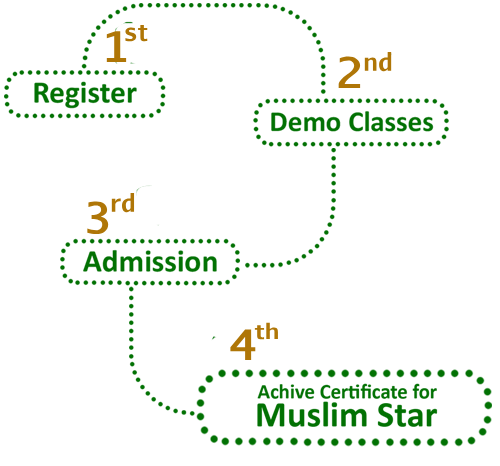
Simple 4-Step Process
Register today and attend a 3-day free demo class before enrolling in regular sessions.
get a free trail class
It takes less than a minute. Our team will contact you shortly.